Reader Essay · August 2026 · 8 min read
I Taught Piano for 38 Years. Then I Began Losing My Students' Names — Until a Quiet Daily Sound Helped Me Find Them Again.
I built a whole life on rhythm and recall. When both started slipping, I assumed it was simply my age talking. My niece — and a stack of research papers — convinced me otherwise.

For thirty-eight years, my memory was my instrument. I could hold three hundred students' names in my head, along with their recital pieces, their nervous habits, and which measure of Clair de Lune would trip them up. Parents used to joke that I remembered their children's fingerings longer than they remembered their children's shoe sizes. I never wrote any of it down. I never had to.
So I can tell you the exact moment I got scared. It was a Tuesday afternoon two springs ago. A former student — a girl I'd taught for nine years, whose wedding I had attended — stopped me at the farmers' market, hugged me, and said, "Mrs. Whitmore!" And I stood there, smiling at this young woman I loved, reaching for her name the way you reach for a light switch in your own home… and touching nothing but wall.
It wasn't the first slip. There had been little ones for a while. Walking into the kitchen and losing the errand on the way. Re-reading the same paragraph of my novel three times at night. Telling Frank a story and feeling the ending dissolve mid-sentence. Each one, on its own, was easy to laugh off. Everyone does that, people say. And everyone does.
But I had spent four decades listening for the smallest change in a student's timing — the half-beat of hesitation that tells you the piece isn't really learned yet. I knew the difference between a wrong note and a pattern. This was starting to feel like a pattern.
The dinner conversation that changed my mind
My niece Claire is a graduate researcher in a sleep-and-memory laboratory out in Boston — the family's one true scientist, the one we all save our medical questions for at Thanksgiving. Last summer she stayed with us for a week, and one evening on the porch I finally said the thing out loud: "Claire, I think my memory is going soft on me."
She didn't do what I expected. She didn't reassure me, and she didn't look alarmed. She put down her lemonade and asked me the strangest question I'd heard in years:
"Aunt Ellen — do you know what your brain sounds like?"
I laughed. She didn't. She explained that if you attach sensors to a person's scalp, you don't hear thoughts — you see rhythms. Waves. Millions of brain cells firing together in time, like sections of an orchestra. Scientists have been recording those rhythms for almost a hundred years, and they have names: fast, tight beta waves when you're juggling and worrying. Smoother alpha waves when you're calm. And a slow, deep, rolling rhythm called theta.
"Theta is the one you'd care about," she said. "It shows up strongly in the hippocampus — the brain's memory librarian. When researchers watch people successfully form and recall memories, theta rhythms are very often right there in the middle of it."2,3
"You of all people should understand this," Claire told me. "You spent your whole career fixing people's tempo. Memory has a tempo too."
And then she said the sentence that stuck with me for days: modern life almost never lets us slow down into those deeper rhythms. We wake to alarms, scroll at breakfast, worry through lunch, and fall asleep with the television on. We spend our whole day playing allegro, she said — and the filing, sorting, remembering part of the mind does its best work adagio.
What I found when I did my own homework
I am not a scientist, but I was a teacher, which means I don't take anyone's word for anything — not even Claire's. After she left, I spent two weeks with my library card and a laptop, reading everything I could find on brain rhythms and memory. Some of it was over my head. But three things kept showing up, in paper after paper:1,2,3
First: the connection between theta rhythms and memory isn't fringe science. It has been measured in university laboratories for decades — including studies recording directly from the human hippocampus while people memorize and recall.2
Second: these rhythms respond to what we do. Researchers have spent years studying how the brain's timing shifts with rest, attention — and sound. There's a whole body of work on structured audio, including "binaural" tones that present a slightly different frequency to each ear, and its relationship to relaxation, mood, and memory performance.4
Third: and this is the one that gave me goosebumps — in 2019, researchers reported in a major neuroscience journal that when they gently re-synchronized the brain rhythms of adults in their sixties and seventies, aspects of their working memory temporarily performed more like adults decades younger.5 Rhythm wasn't just a side effect of memory. It looked more like part of the machinery.
None of this promised anything. Careful researchers hedge every sentence, and they should. But as an idea, it made a kind of sense to me that nothing else had: maybe my mind didn't need to be pushed harder. Maybe it needed to be given the beat.
The metronome principle
Here is how I finally understood it, in my own language. Every teacher knows this scene: a student is rushing a piece, stumbling, fighting their own hands. You don't shout at them to concentrate — concentrating harder is exactly what's breaking the piece. You set the metronome ticking, quietly, underneath. And within a minute, without being told, their playing settles onto the beat. The hands relax. The music comes back.
Nobody forces that to happen. It's just what we do around a steady rhythm — we join it.
When Claire called that Sunday, I told her about my reading and my metronome theory, and I could hear her smiling down the phone line. That, she said, was the plain-English version of what scientists call entrainment — and it was also, roughly, the thinking behind something she'd been meaning to send me: a listening program that a team of audio engineers had built around exactly this body of research. It was called Genius Brain Signal.
"It's basically a metronome for the quiet part of your brain," she said. "Fifteen minutes. Headphones. That's the whole assignment."
What's actually inside the sound
I'll be honest: the name made me roll my eyes a little. I've lived long enough to distrust anything with "genius" printed on it. But when I looked into how the audio itself was put together, it read less like a gimmick and more like a recipe — a handful of deliberate ingredients layered into what simply sounds, to the ear, like deeply calming music:
A theta-range foundation
The slow, deep pulse at the base of every session — tuned to the same unhurried range researchers keep finding alongside memory work in the brain.2,3
A gentle way down
Softer alpha-range tones open each session, easing you out of the day's noise gradually — the way a good piece never starts at full volume.
Two ears, two tones
Each ear receives a slightly different frequency — the long-studied binaural technique4 — which is why the program asks for headphones and nothing else.
Music you'd actually choose
The engineering hides inside warm, natural soundscapes. To you it's simply beautiful listening; the structure underneath does the quiet work.
🎧 Everything arrives as digital audio — you stream it or download it, on any phone, tablet or computer, with any ordinary pair of headphones.
My fifteen minutes
I decided to treat it the way I'd ask a student to treat a new piece: every day, short and honest, no skipping, no judging the results for a month. I chose the fifteen minutes after breakfast, in the armchair by the window, headphones on, eyes closed. Frank called it my "appointment." He wasn't entirely joking by the end.
No fireworks — just the deepest exhale I'd taken in months. Whatever else it was, it was the most relaxing quarter-hour of my week, and that alone kept me coming back.
The afternoons felt different first. Less of that 3 PM static. I finished my library book — the same one I'd been re-reading paragraphs of since spring.
Small things started arriving on time. Errands survived the walk to the kitchen. And one Sunday at church, a name I hadn't needed in years was simply there, waiting, before I'd even reached for it.
I still play the piano with slipping fingers, and I still lose a word now and then — I'm seventy-one, not twenty-one. But the fog doesn't frighten me anymore. My mornings belong to me again. So do my students' names.
I want to be careful here, because I was a teacher and precision matters: I cannot promise you my experience. Nobody honestly can — every mind is its own instrument. What I can tell you is that this was the easiest habit I have ever kept, and the first thing in years that made me feel like I was doing something for my mind instead of just worrying about it.
I'm not the only one
After I wrote about my "appointment" in our community newsletter, I started hearing from other listeners — neighbors, old colleagues, strangers who found the program the same way I did. A few of their notes, shared with permission:
"My work brain always felt like fifty browser tabs fighting each other. This is the one thing that closes them. I do my fifteen minutes at lunch and the afternoon actually belongs to me."
"I bought it for the memory side, but the surprise was the calm. My husband started asking what I was listening to — now there are two pairs of headphones on the nightstand."
"Retired engineer, professional skeptic. I gave it thirty days because the references checked out. I'm on day ninety-something now, if that tells you anything."
Individual experiences; results vary from person to person.
If you'd like to try what I tried
Claire had to explain to me how these things are sold — no boxes, no shipping, just instant access on whatever device you own. The team behind the program currently offers the complete package for less than I used to charge for a single piano lesson, and they give you a full three months to decide whether it's for you. That last part is what finally moved me from reading to trying, so I'm passing all of it along exactly as I found it:
Genius Brain Signal — Full Digital Access
Everything below is included with a single one-time purchase. Nothing ships; everything is available minutes from now.
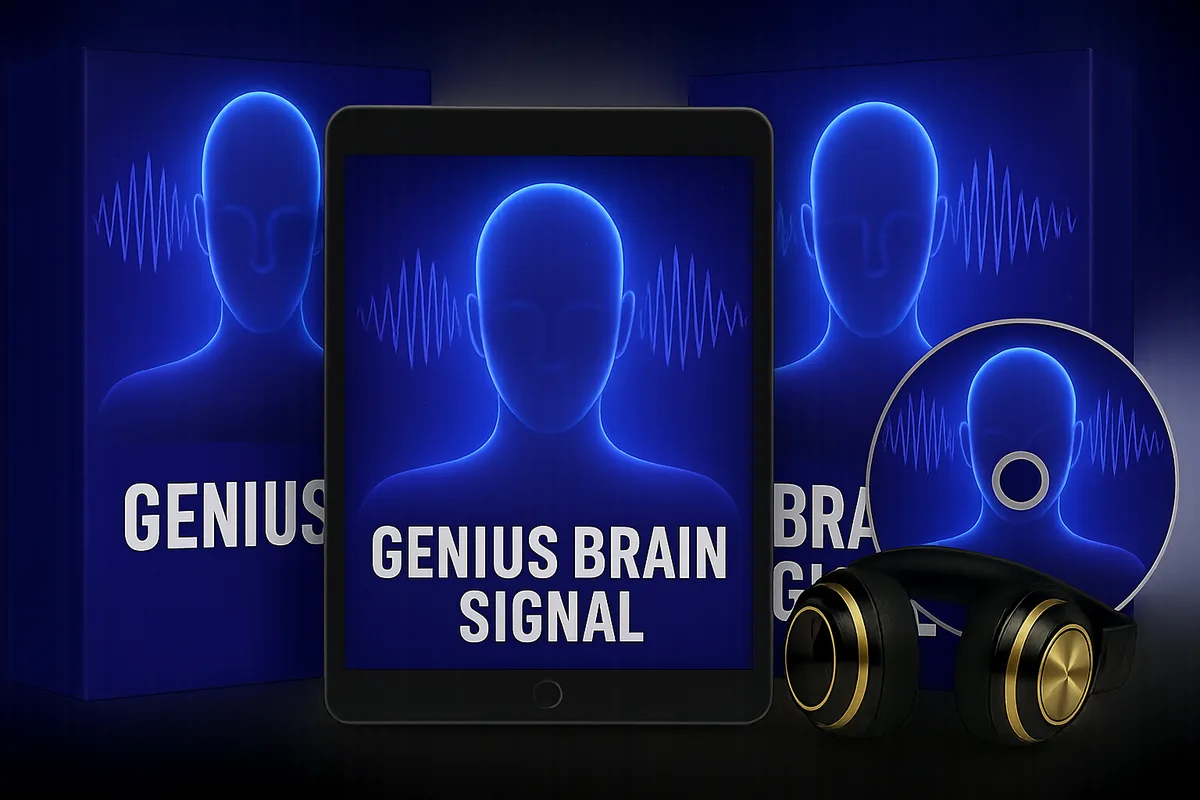
- The Genius Brain Signal Audio ProgramThe complete engineered listening sessions — the daily "appointment" itself. $197 value
- Bonus: Quick Start GuideSo your first session is set up right in five minutes. $97 value
- Bonus: Theta Money Magnet AudioA companion session for quiet, abundance-focused visualization. $97 value
- Bonus: The 10X Learning Accelerator GuidePractical techniques for absorbing new material at any age. $97 value
One-time payment · instant access · no subscription, ever
Get Instant Access — $37Listen daily for a full season. If you don't genuinely feel calmer and clearer, one email gets you every penny back — no questions, no forms, no hard feelings.
Questions my friends keep asking me
Is this music? Meditation? What is it exactly?
Do I need special equipment?
How long before I notice anything?
Is it a subscription?
Is this a medical treatment?
P.S. — If you take one thing from an old teacher, let it be this: don't wait for a crisis to give your mind fifteen quiet minutes a day. Whether it's this program or simply a chair by a window, your memory keeps the tempo of your whole life. Mind the tempo. — Ellen
Background & further reading
The published research that shaped my understanding. These studies examine the underlying science of brain rhythms, sound and memory; they are not studies of this product.
- Klimesch, W. (1999). EEG alpha and theta oscillations reflect cognitive and memory performance: a review and analysis. Brain Research Reviews, 29(2–3), 169–195.
- Lega, B. C., Jacobs, J., & Kahana, M. (2012). Human hippocampal theta oscillations and the formation of episodic memories. Hippocampus, 22(4), 748–761.
- Herweg, N. A., Solomon, E. A., & Kahana, M. J. (2020). Theta oscillations in human memory. Trends in Cognitive Sciences, 24(3), 208–227.
- Garcia-Argibay, M., Santed, M. A., & Reales, J. M. (2019). Efficacy of binaural auditory beats in cognition, anxiety, and pain perception: a meta-analysis. Psychological Research, 83(2), 357–372.
- Reinhart, R. M. G., & Nguyen, J. A. (2019). Working memory revived in older adults by synchronizing rhythmic brain circuits. Nature Neuroscience, 22(5), 820–827.